The field library / Collection 02
Blue lace agate.
Pale blue, in gentle lines.
Blue lace agate is a pale blue-and-white banded chalcedony trade variety. Its fine curved lines work especially well across a broad polished surface.
Open the collection card ↓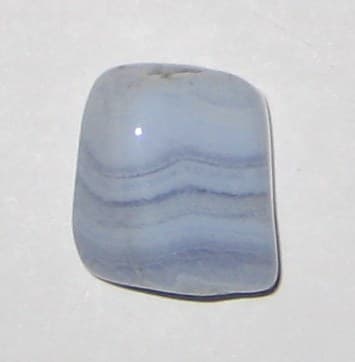
Reference object; not Stone Parade inventory or a product-origin certificate.
01 / The expanded collection card
A name.
A mineral identity.
The name describes a patterned gem material, not a separate mineral species. A soft blue color or lace-like pattern does not by itself certify identity, treatment or locality.
Mindat · Blue lace agate ↗- Material identity
- Mineral variety
- Composition
- SiO₂-rich chalcedony
- Mohs hardness
- 6.5–7
- Luster
- Waxy to glassy
Hardness describes scratch resistance, not resistance to breaking. These values follow the cited material references; reported ranges can vary between publications. Inclusions, mixtures and treatments can affect an individual piece.
02 / A moment of observation
Look a little closer.
Fine curved bands
Look for the rhythm and spacing of the lines.
Translucent edges
Thinner areas may pass more light.
Cutting choices
A cabochon and a bead reveal different portions of the same banded material.
Observation builds familiarity; it does not replace identification. Avoid scratch, acid or destructive tests on a collection piece.
03 / The geological story
Made by the earth.
Recorded with care.
How it forms
Successive silica-rich layers can create fine bands in chalcedony. A cut across those layers turns growth into a visible pattern.
Mindat · Blue lace agate ↗An example to explore
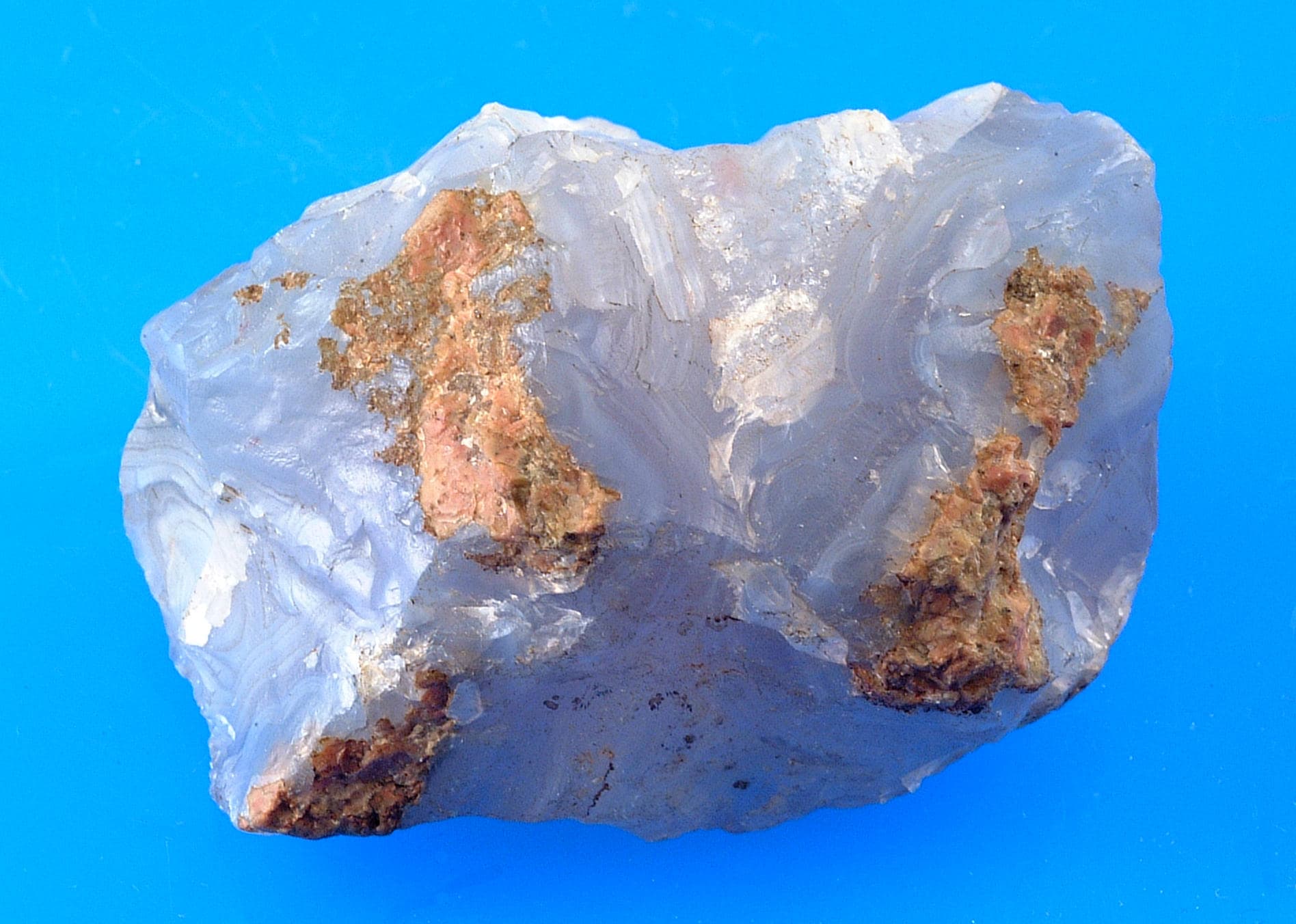
Namibia / attributed reference photo
The linked Commons photograph is attributed to material from Namibia. It illustrates a locality record rather than proving the origin of any similarly colored product.
Reference photograph · collection record ↗What does this tell me about my stone?
A recorded occurrence gives geological context. Your Stone Parade piece needs its own batch information before a locality can be stated. Keep an original specimen label or documented supplier record with the collection card.
04 / From a material to an object
Ways to wear.
Ways to keep.
A pause in pictures
From earth to everyday.
A visual look at blue lace agate and jewelry forms inspired by its palette.
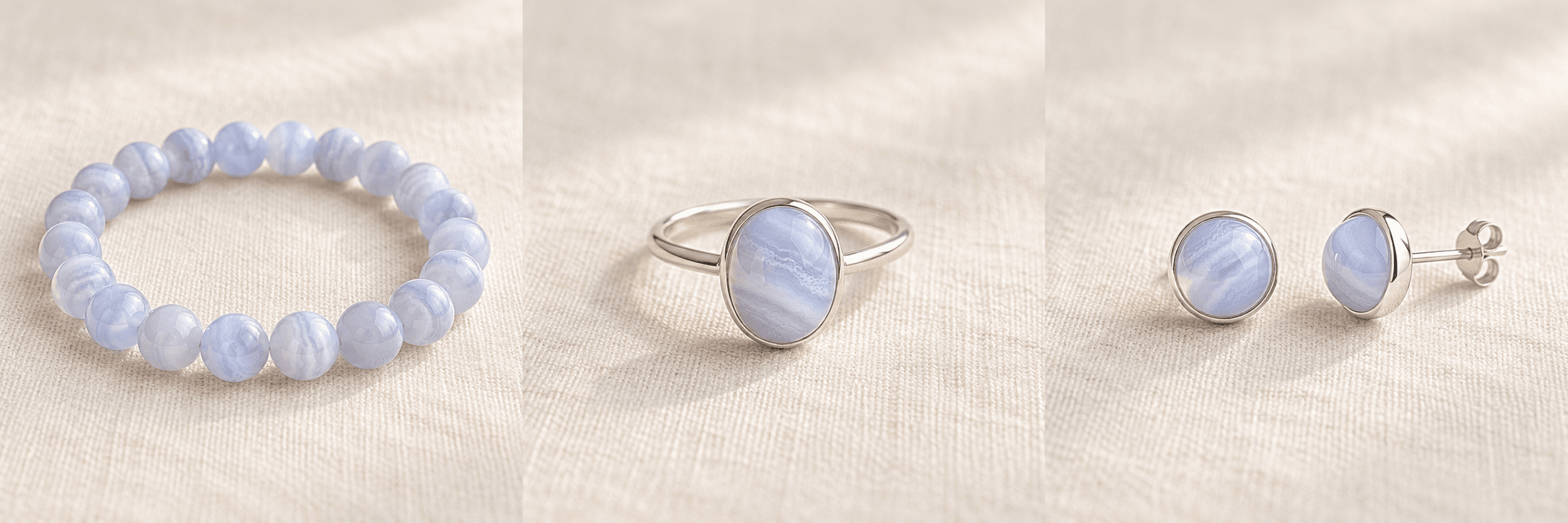 Style referenceStyle referenceStyle referenceReference photograph
Jewelry forms are shown for learning and inspiration. Style references illustrate design possibilities; they do not establish mineral identity or origin. Pictured styles, including earrings, are not promised box contents.
Jewelry & practical use
Beads and cabochons emphasize broad color and pattern; a collector specimen preserves natural surfaces. The bracelet, ring and stud images below are style references, and the exact material, setting and treatment determine suitability.
One useful distinction
A raw stone describes a finish. A mineral specimen describes an object kept for its features or locality. The terms can overlap, and a specimen does not have to be large.
In Stone Parade, the mineral selection may be a raw stone or a collector-sized mineral specimen.
05 / A little thoughtful care
Keep the beauty.
Keep the story.
Choose a method for the whole object: stone, matrix, cord, metal and any treatment. A care shortcut that suits one material can damage another.
Clean conservatively
Start with a soft dry cloth or a very soft brush. Check the treatment, setting and any attached matrix before using water or a cleaner.
Protect the surface
Store separately in a padded compartment. Scratch hardness does not measure resistance to chipping or cleavage.
Choose the setting thoughtfully
Inspect bead holes, edges and prongs. A specimen on matrix needs support, while a ring is exposed to more knocks than a pendant.
Before you collect / treatments, names & provenance +
Ask for the material name, any treatment and the evidence behind a locality claim. Price, color and an attractive photograph cannot replace identification or a documented specimen label.
Personal symbolism is individual. The crystal-culture section explores symbolism separately from the mineral science and care references.
Another way to connect / Crystal culture
Meaning, energy
& personal ritual.
Alongside its geological story, blue lace agate can become a personal symbol. Explore healing traditions and chakra language as cultural beliefs and reflection prompts.
Symbolic associations, not established medical effects. Crystals have not been shown to treat illness or balance a measurable human energy field.
Your reflection themes
✧Calm & rest ↗
A quiet mood and a pause from the pace of the day.
Communication ↗
Thoughtful expression, listening and finding words for an intention.
Stone Parade editorial pairings for this chapter’s color or featured variety. Interpretations differ among authors and practitioners.
A chakra reading lens
Throat / Vishuddha
A symbolic focus on listening, expression and speaking thoughtfully.
A contemporary seven-center, color-based reading guide. Chakras belong to South Asian spiritual traditions; these stone pairings are not a universal ancient chart or anatomical structures.
Place the stone nearby and take a brief, comfortable pause without expecting the stone to change your health. Keep delicate stones safely on a surface; no water, salt or heating is needed.
Healing, energy & the sources behind this section +
In contemporary crystal practice, “healing” and “energy” often describe beliefs about subtle energies, intention and personal experience. Such language is different from measured mineral properties or demonstrated treatment effects. This section offers optional symbolism and does not replace healthcare.
The museum sources document beliefs and objects, not clinical efficacy. In a 2025 controlled study of rose quartz and a matched placebo, anxiety changes did not show a crystal-specific benefit beyond placebo. That study does not test every stone or every practice.
Our tags are transparent editorial reflection pairings, informed by the contemporary color-based approach; these sources do not validate every stone-to-chakra correspondence. Mineral science references remain in the chapter’s own research section.
06 / Follow the research
Curiosity, with
something to follow.
Care references & editorial notes +
Care suggestions combine the specific sources above with GIA’s jewelry care guidance. Recommendations are deliberately conservative when a piece’s treatment or matrix is unknown. IMA-CNMNC and RRUFF provide further nomenclature and analytical research; listing them does not imply laboratory testing of a Stone Parade item. Some older Handbook entries preserve historical names; chapter-specific modern nomenclature references take precedence where noted.
Reference properties and locality examples reviewed October 30, 2026. Photographs show particular objects. Jewelry style studies show possibilities, not an inventory promise.
Keep your curiosity going